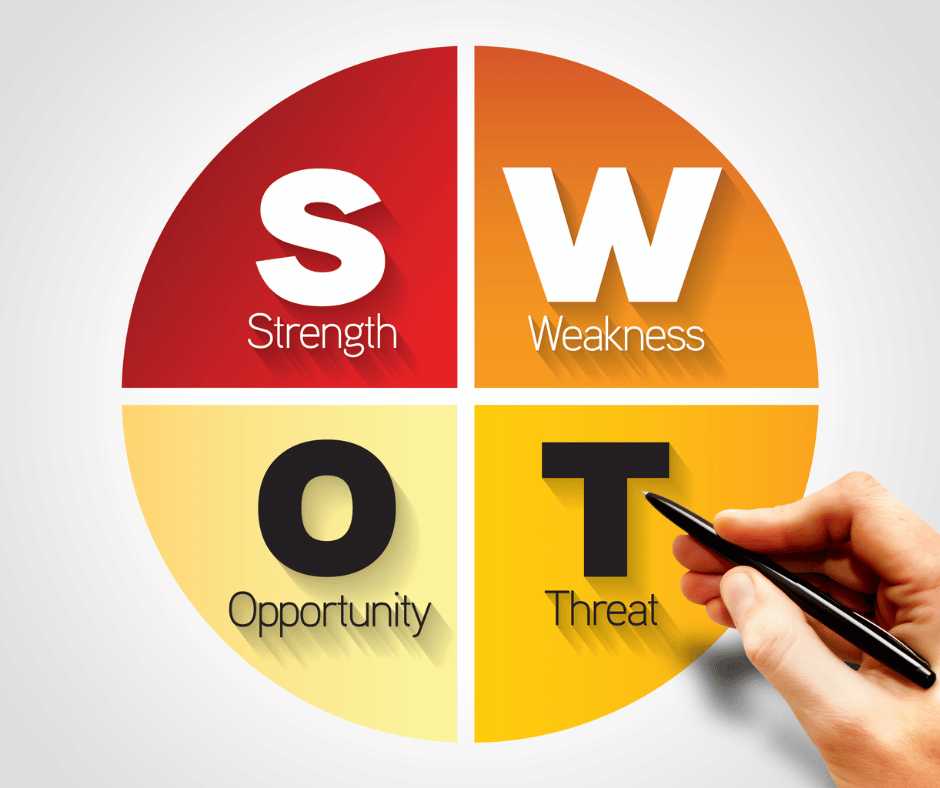
A SWOT analysis is a powerful tool for strategic planning and management, which helps you assess the internal and external aspects of your organisation or project. This analysis brings together four key components: Strengths, Weaknesses, Opportunities and Threats.
In this article, we will look at how to carry out a SWOT analysis in practice and how this tool can help you identify the right strategy for business success.
Strengths
Strengths are the internal aspects of your organisation or project that give you a competitive advantage. To identify your strengths, ask yourself the following questions:
- What unique resources and skills do we have?
- What are our best products, services or projects?
- What is our reputation and what is our brand?
- What are our key assets?
Examples of strengths might include highly motivated staff, innovative products, an excellent management team or a well-established customer base.
Weaknesses
Weaknesses represent the internal limitations and shortcomings of your organisation or project. To identify these weaknesses, ask yourself the following questions:
- Where are we ineffective or inefficient?
- What gaps do we have in terms of resources or skills?
- What are our biggest shortcomings and obstacles?
- How can we improve our weaknesses?
Examples of weaknesses might include a lack of funding, ineffective management, limited resources, poor operational processes or an untrained team.
Opportunities
Opportunities are external aspects of your organisation or project that offer you the chance for growth and development. To identify these opportunities, ask yourself the following questions:
- What are the current trends in our market?
- What new technologies or innovations could give us an edge?
- What new markets or customers could we serve?
- What are our competitive advantages?
Examples of opportunities might include market expansion, new technologies, growing interest in your products, changes in consumer behaviour, or changes in legislation that support your business at a fundamental level.
Threats
Threats are external factors that could hinder or destroy your organisation or project. To identify threats, ask yourself the following questions:
- Who are the current and future competitors?
- What are the economic and financial risks?
- What are the social, political or environmental factors that might affect us?
- What are the risks associated with seasonality or market volatility?
Examples of threats might include increased competition, an economic recession, changes in regulations or pervasive social trends that have a negative impact on your business.
Preparing a SWOT Analysis
Once you have answered the questions and identified the strengths, weaknesses, opportunities and threats, you can create a SWOT matrix. This matrix is a tool that helps you assess all the components and define a development strategy. Here’s how to do it:
- Draw up a list of strengths and weaknesses using the information you have gathered.
- Draw up a list of opportunities and threats, including external factors that may affect your business.
- Create a SWOT matrix by placing the strengths and weaknesses in the inner quadrant and the opportunities and threats in the outer quadrant.
- Analyse the relationships between the components to identify strategies for capitalising on strengths, addressing weaknesses and exploiting opportunities, whilst managing threats.
- Develop strategies and specific steps that will help you use the SWOT analysis to achieve your objectives.
In conclusion
A SWOT analysis is a powerful tool that helps you assess your business or project by combining internal and external aspects of the environment. This analysis provides a clear picture of your strengths, weaknesses, opportunities and threats, and helps you develop a strategy for success based on an analysis of this information, which is key to your future.
Don’t forget that a SWOT analysis needs to be updated regularly, as the conditions and context of any business are dynamic and could change rapidly in today’s fast-paced world.